

Opening your water bill is a bit like checking your bank balance after a long weekend in Fitzroy. You know it’s coming, you’re fairly sure you can handle it, and the number still makes you wince. If you’re a young professional renting in Brunswick or paying off a first place in Footscray, the average water bill Melbourne households face in 2026 is worth understanding properly, because the answer changes depending on whether you own or rent.
I’ve written this guide from a plumber’s-eye view. We’ll compare what owners and tenants pay, break down the quarterly figure, and look at where to find help if things get tight. Everything below leans on the Victorian regulator’s 2026-27 figures, so you’re working with real numbers rather than pub-table guesswork.
What Is the Average Water Bill Melbourne Households Pay in 2026-27?
The average water bill Melbourne 2026 figures show for owner-occupiers sits at roughly $1,145 to $1,222 a year, depending on which retailer services your suburb. Renters pay far less, around $398 to $582 a year. Those indicative figures come from the Essential Services Commission’s final decision on Melbourne Water’s prices, shown in 2026-27 dollars and based on typical household use. The regulator also says the average owner-occupier bill in Melbourne will rise by about $73, or seven per cent, once an allowance for the desalinated water order is included.
Your retailer matters here. Greater Western Water looks after the west, Yarra Valley Water covers much of the north and east, and South East Water handles the south-east. Each sets its own tariffs inside the regulator’s limits, which is why two mates in different postcodes can compare bills and swear one of them is being robbed.
| Retailer | Owner-occupier annual bill (2026-27) | Change from 2025-26 | Renter annual bill (2026-27) | Change from 2025-26 |
| Greater Western Water (Central) | $1,162 | +$92 | $548 | $0 |
| Greater Western Water (Western) | $1,222 | +$73 | $398 | –$1 |
| South East Water | $1,145 | +$87 | $579 | +$12 |
| Yarra Valley Water | $1,176 | +$62 | $582 | +$39 |
Source: Essential Services Commission final decision on Melbourne Water’s prices, June 2026. Indicative bills in 2026-27 dollars.
The gap between owners and renters isn’t because tenants are secretly showering for two minutes flat. It’s because of how the bill is split, which brings us to the next section.
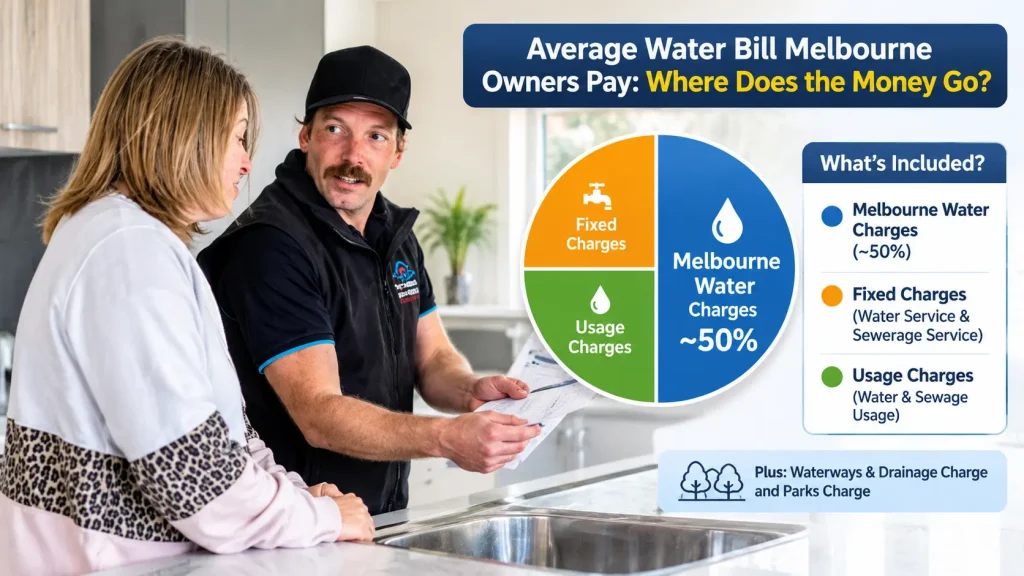
Average Water Bill Melbourne Owners Pay: Where Does the Money Go?
If you own your home, you get the whole bill, fixed bits and all. Under Victorian water billing rules, owner-occupiers receive charges for both the fixed and usage parts of the service, while tenants are billed for usage only. That’s why homeowner water charges Melbourne wide look so much heftier than what your renting mate pays, even when you both use similar amounts of water.
Think of it like a gym membership: you pay the monthly fee whether you turn up or not. Fixed water service charges Melbourne retailers collect work the same way, covering the pipes and sewers that sit ready for your 6am shower. Fixed charges can even move against the total. South East Water’s quarterly water service charge drops from $21.97 to $19.49 in 2026-27, even though the overall bill climbs.
Here’s what typically sits inside the average water bill Melbourne owners receive:
- Water service charge: a fixed amount that covers keeping you connected to the supply.
- Sewerage service charge: a fixed amount for the sewer network that carries everything away.
- Usage charges: what you pay for the water you actually use, plus the sewage disposal linked to it.
- Waterways and drainage charge: $130.56 a year for residential properties in 2026-27, up $5.55, collected for Melbourne Water.
- Parks charge: a levy that funds Melbourne’s parks and public spaces. Yarra Valley Water lists a minimum annual amount of $92.26 for 2026-27.
Melbourne Water’s wholesale charges make up about half of a typical metropolitan household bill, which is handy to know the next time someone blames the retailer for everything. Together, these Melbourne water rates and fees explain why the average water bill Melbourne owners see keeps creeping up, even after you’ve swapped to a water-saving showerhead and felt smug about it.
Melbourne Water Charges for Tenants: What Renters Actually Pay
Here’s the good news if you rent, because the average water bill Melbourne tenants carry is far lighter. According to the Victorian Government, tenants receive a bill from the water and sewerage provider for usage, while the property owner receives the fixed charges. That means Melbourne water charges for tenants are limited to what you actually use, rather than the full package of connection, drainage and parks charges.
The 2026-27 numbers show how this plays out. Water bill cost for renters Melbourne wide ranges from about $398 a year in Greater Western Water’s western region to about $582 with Yarra Valley Water. Greater Western Water’s central region renters see no change at all, whereas Yarra Valley Water renters pay about $39 more than last year. So the average water bill Melbourne tenants face is real money, but it’s a fraction of what the landlord’s side of the ledger costs.
There’s one catch I see tenants miss all the time. Tenant water usage charges only apply in certain situations under Victorian rules. Generally, your landlord can only pass usage charges on if the property is separately metered and meets water efficiency requirements, and your lease should spell this out. If you’re unsure, check your lease and the Consumer Affairs Victoria guidance before you pay a bill that lands in your inbox with a landlord’s cheerful “just forwarding this on!” message.
If your usage seems oddly high, speak up early. A leaking toilet isn’t your fault, but you may be the one paying for the water it wastes. Your landlord is typically responsible for fixing it, so report it in writing.
Melbourne Water Bill Payment Assistance and Victorian Water Billing Rules
Now for the part nobody wants to read but everyone eventually needs. If the average water bill Melbourne households pay still feels out of reach, you have more options than you might think. The Victorian Government’s help paying your bills page says your first step is simply to contact your water corporation, and that conversation can unlock several kinds of support.
Under Victorian water billing rules, water businesses must tell you what help is available if you’re struggling. The Essential Services Commission says they must offer flexible payment plans and can extend the due date on some or all of the amount you owe. In my experience, people leave this conversation far too late. Retailers are generally far more flexible when you call before the bill is overdue rather than after.
Beyond that, Melbourne water bill payment assistance includes two main government-backed supports. The first is a concession: eligible pensioners and health care card holders can get up to 50 per cent off their annual water and sewerage bill. Make sure the name and address on your bill match the details on your concession card, or the discount may not apply. The second is the Utility Relief Grant, which helps eligible cardholders facing a temporary financial crisis. It covers up to $650 every two years for a single utility, or $1,300 every two years across all utilities, and you apply for each utility separately.
If you’re unhappy with how your water corporation has handled your account, the Energy and Water Ombudsman deals with disputes about water providers.
Average Quarterly Water Bill Melbourne: What Lands in Your Letterbox
Most Melburnians don’t think about the average water bill Melbourne wide in annual terms. You think in “this bill just arrived” terms. So let’s translate. Divide the annual owner-occupier figures by four and the average quarterly water bill Melbourne owners receive works out at roughly $286 to $306. For renters, the quarterly figure is about $100 to $146. These are simple estimates, and your actual bill will depend on your usage and billing cycle.
The new financial year has also nudged quarterly bills along. Yarra Valley Water says bills rise by an average of 5.7 per cent from 1 July 2026, which means about $16 more per quarter for a typical homeowner and about $10 more for a typical renter. If your latest bill felt heavier than the last one, you weren’t imagining it.
One more thing worth knowing: the average water bill Melbourne retailers quote assumes about 150 kilolitres of water a year. A single professional might come in well below that, and a share house of four might blow straight past it. Treat the average as a ruler, not a verdict.
Why Your Bill Isn’t the Average Water Bill Melbourne Quotes
Averages are slippery things. Stand with one foot in a bucket of ice and the other in a fire, and you’re comfortable on average. A few unusual habits or one hidden problem can shove your bill far from the average water bill Melbourne reports. Household size is the obvious driver, and your retailer area matters too, as the table above shows. Older toilets and ageing taps also quietly add litres you never notice.
But the biggest culprit I see on the tools is the leak nobody knew about. A running toilet or a pinhole in a pipe under the slab can quietly waste hundreds of litres a day, and you only find out when the quarterly bill makes you spit out your flat white. If your bill jumps without a change in your routine, that’s your cue to investigate rather than just pay and sigh.
Spotting Hidden Leaks That Inflate Your Average Water Bill Melbourne Households Pay
Leaks are sneaky because water doesn’t announce itself. Here are the signs I’d check first, plus a five-minute test:
- The meter test: turn off every tap and appliance, then check your water meter. If the dial keeps moving, water is going somewhere it shouldn’t.
- Damp patches or musty smells: walls, ceilings or floors that feel cool, soft or smell earthy often point to a hidden leak.
- Unusually green or soggy patches in the garden: a burst pipe underground can make one patch of lawn look suspiciously lush.
- The sound of running water: if you can hear trickling when everything is off, take it seriously.
- A sudden bill spike: if your usage jumps with no change in routine, a leak is the first thing to rule out.
If the meter keeps ticking, don’t wait for the next bill to confirm your suspicion. Professional leak detection can pinpoint the problem without tearing up half your yard. It’s usually cheaper than a few quarters of bills sitting well above the average water bill Melbourne homes receive, and it protects your home from slow water damage.
Practical Ways to Bring Your Bill Closer to (or Below) the Average
Once the leaks are sorted, the rest is habits and hardware. You don’t have to become the person who times everyone’s showers with a stopwatch.
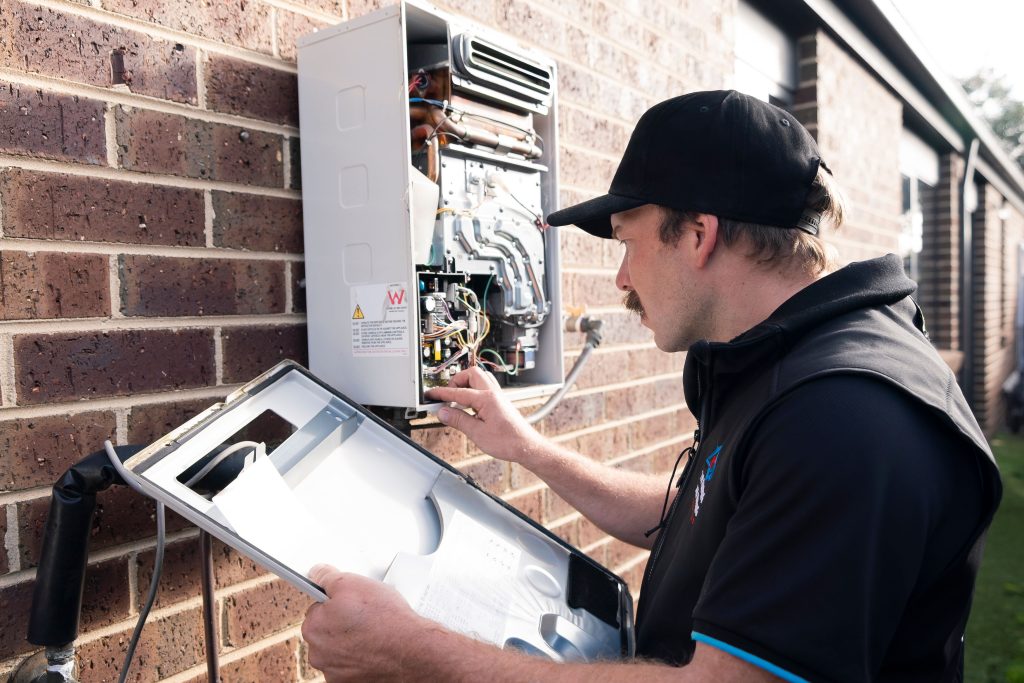
Start with the fittings. Water-efficient showerheads, taps and dual-flush toilets cut the water you use without changing how your day feels. If your hot water system is old, get it checked too, since a faulty valve can waste water and energy at once. Our team can help with hot water system repairs and replacements if yours is on its last legs. Renters may not control the plumbing, but you control behaviour: full loads in the dishwasher, shorter showers and reporting drips quickly.
Finally, compare each new bill with the last one. A steady pattern means all is well, while a sudden climb means it’s time for an inspection from a licensed plumber who can look at the whole system. Our general plumbing services cover the lot, and keeping the average water bill Melbourne households pay under control starts with catching problems early.
Final Thoughts on the Average Water Bill Melbourne Residents Face
The average water bill Melbourne owners pay in 2026-27 sits at about $1,145 to $1,222 a year, while renters pay roughly $398 to $582, because owners also cover the fixed charges, waterways and drainage, and parks levies. Quarterly, that’s roughly $286 to $306 for owners and $100 to $146 for tenants. Your retailer, household size and the condition of your plumbing all push your own figure above or below the average, and hidden leaks are the most common reason bills spike unexpectedly. If you’re struggling, Victorian water billing rules mean help is available through payment plans, concessions and the Utility Relief Grant, and it’s always better to ask early.
If your bill looks higher than the average water bill Melbourne households should be paying, don’t just grumble and pay it. Get in touch with The Plumbing And Roofing Company today, and we’ll check for leaks, inspect your fixtures and hot water system, and help you take control of your usage. Visit our contact page or call the team to book a licensed plumber who treats your home like their own.
Frequently Asked Questions About the Average Water Bill Melbourne
1. What is the average water bill Melbourne households pay per quarter?
For owner-occupiers, the average quarterly water bill Melbourne households receive in 2026-27 works out at roughly $286 to $306, based on annual indicative bills of about $1,145 to $1,222. Renters typically pay around $100 to $146 a quarter. These are estimates based on the regulator’s typical household usage, so your own bill will move up or down depending on how much water you use and which retailer services your suburb.
2. Do tenants pay water bills in Melbourne?
Yes, but usually only the usage part, which is why the average water bill Melbourne tenants pay is much lower than owners’. The Victorian Government explains that tenants receive a bill for usage while the property owner receives the fixed charges. Tenant water usage charges generally apply only if the property is separately metered and meets water efficiency requirements, so check your lease and Consumer Affairs Victoria guidance if you’re unsure whether you should be paying.
3. Why is my water bill higher than the average water bill Melbourne reports?
The average assumes a typical household using about 150 kilolitres a year, which may not match your reality. Household size, your retailer, the age of your fixtures and hidden leaks all push your bill higher or lower. If your bill jumps without a clear reason, do a quick meter test and call a licensed plumber to check for leaks, because even a small leak can waste a surprising amount of water over a quarter.
4. Can I get help if I can’t pay my water bill in Victoria?
Yes. Contact your water corporation early and ask about payment plans, due-date extensions and hardship support. Eligible pensioners and health care card holders can receive up to 50 per cent off their annual water and sewerage bill, and the Utility Relief Grant can help with overdue bills in a temporary financial crisis, up to $650 every two years per utility. The Victorian Government’s help paying your bills page has the full details.
5. How can I tell if a leak is inflating my water bill?
A hidden leak can push you well past the average water bill Melbourne households see. Turn off all taps and appliances, then watch your water meter for five to ten minutes. If the dial moves, water is escaping somewhere. Other signs include damp patches, musty smells, unexplained soggy areas outside and the sound of running water when everything’s off. A licensed plumber can use specialist equipment to locate the leak without unnecessary digging.


